What Are Flange Insulation Gasket Kits and What Are They Used For? Picture a coastal gas line where a steel flange pair sits in humid air, a cathodic protection system is running, and a maintenance team is about to bolt up a joint that must stay electrically isolated for years. That is the moment flange insulation gasket kits earn their place. A kit is not just a gasket; it is a complete dielectric break that separates dissimilar metals, interrupts galvanic corrosion, protects cathodic protection current, and keeps pipe sections from becoming an unintended electrical path. For buyers, the challenge is practical: one missing insulating washer, the wrong sleeve length, or a gasket material that creeps under torque can turn a low-cost kit into a costly leak, rework, or compliance finding. A good kit must match flange standard, pressure class, temperature, media, bolt size, and installation torque. It should arrive as a controlled set—gasket, sleeves, washers, and often steel washers—so crews do not mix parts or improvise. This guide explains what flange insulation gasket kits are, where they are used, how to specify them, and how to avoid the procurement traps that appear when price is compared without service conditions. It also shows how Ningbo Kaxite Sealing Materials Co., Ltd. supports buyers with material selection, dimensional checks, and batch traceability for oil and gas, water, chemical, power, and marine pipeline projects.
Article Outline

Why Flange Insulation Gasket Kits Matter in Real Pipeline Systems
The painful scene is familiar to every pipeline procurement team: a requisition says “gasket kits” with no material datasheet, no bolt coating detail, and no service media. The site has seawater, 80 °C ambient heat, 150 lb flanges, and a cathodic protection system that must not be shorted. A low-cost kit arrives, the crew installs it, and months later the joint shows creep, corrosion under the washer, or electrical continuity that should not exist. The problem is rarely the gasket alone; it is the missing specification logic around the whole kit.
The practical fix is to treat the kit as an engineered isolation assembly. Define the flange standard, pressure class, temperature, media, bolt size, and required dielectric performance before comparing quotes. Ningbo Kaxite Sealing Materials Co., Ltd. helps buyers convert these inputs into a controlled bill of materials, so the gasket, sleeve, and washer set work together instead of being sourced as loose parts. This is how procurement teams reduce installation rework and keep cathodic protection current where it belongs.
| Parameter | What to Confirm | Why It Matters | Kaxite Check |
|---|---|---|---|
| Flange standard | ASME B16.5, EN 1092, API 6A | Dimensional fit and bolt hole alignment | Drawing review |
| Pressure class | 150 to 2500 | Gasket compression and extrusion risk | Thickness recommendation |
| Temperature | −50 to 180 °C, material dependent | Creep, hardening, and sealing stability | Material datasheet |
| Media | Seawater, hydrocarbon, gas, chemicals | Chemical compatibility and swelling | Application review |
| Electrical isolation | Dielectric strength and continuity check | Cathodic protection and galvanic corrosion control | Batch and test records |
When these parameters are written into the RFQ, flange insulation gasket kits stop being a commodity line item and become a reliability decision. The buyer can compare like with like, and the installer receives a set that is ready for the flange face, bolt size, and service condition.
What Is Inside a Flange Insulation Gasket Kit?
Another common pain scene is the site store opening a bag and finding only the isolating gasket. The bolts are ready, the flange is open, and the crew has no insulating sleeves or washers. Improvised washers or short sleeves can crush, split, or create a metal-to-metal bridge. The result is a joint that looks complete but fails the isolation test.
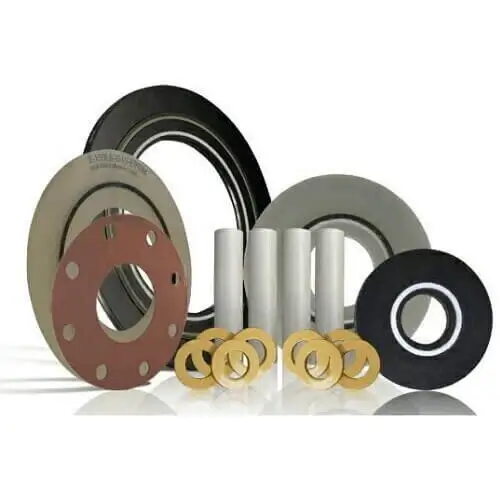
A proper kit is a system of parts with one job: break every possible electrical path while keeping the flange sealed. Ningbo Kaxite Sealing Materials Co., Ltd. supplies matched kits so each component is dimensionally compatible with the bolt and flange. For procurement, the value is fewer split purchase orders, fewer missing-part claims, and faster turnover to the maintenance crew.
| Component | Purpose | Common Material | Buyer Check |
|---|---|---|---|
| Isolating gasket | Separates flange faces and seals the joint | G10/FR4, phenolic, PTFE | ID, OD, thickness, hole pattern |
| Insulating sleeve | Isolates bolt shank from flange holes | Mylar, G10, PTFE | Bolt size, sleeve length, wall thickness |
| Insulating washer | Isolates nut and bolt head contact faces | G10, phenolic, Mylar | OD, thickness, hardness, quantity |
| Steel washer | Distributes bolt load and protects insulating washer | Zinc-plated steel, stainless steel | Coating, dimensions, bolt match |
A controlled kit also makes inventory easier. Instead of stocking gaskets, sleeves, and washers separately, the buyer receives a complete set per flange size. That reduces pick errors and helps maintenance crews confirm that every isolation point has the parts it needs.
How to Select the Right Kit for Pressure, Temperature, and Media
The painful scenario here is a single kit specification copied across a whole project. A kit that works for dry natural gas at moderate temperature may not suit seawater, brine, or chemical service. If the material swells, creeps, or loses dielectric strength, the flange may leak or the isolation may fail. The buyer then faces a double cost: replacement parts and schedule delay.
The solution is a short selection matrix that links service conditions to kit construction. Ningbo Kaxite Sealing Materials Co., Ltd. reviews media, temperature, pressure class, flange face, and bolt coating before recommending a gasket and sleeve material. This step is especially important for procurement teams buying for multiple sites, because one approved kit family can be standardized without ignoring local service conditions.
| Service Factor | Example | Risk If Ignored | Specification Action |
|---|---|---|---|
| Media | Seawater, brine, fuel gas, chemicals | Swelling, chemical attack, seal loss | Select compatible gasket and sleeve material |
| Temperature | −29 to 120 °C, or higher with special materials | Creep, hardening, torque loss | Confirm continuous and peak temperature |
| Pressure | Class 150 to 2500 | Extrusion and joint movement | Match gasket thickness and compression |
| Flange face | RF, FF, RTJ | Poor contact and leakage path | Specify gasket profile correctly |
| Bolt coating | Xylan, PTFE, zinc, stainless | Galling and sleeve damage | Check sleeve clearance and installation lube |
For procurement staff, the safest approach is to request a written material recommendation with the quote. That single document prevents the common mistake of buying a kit that fits the flange but not the service.
Procurement Risks That Quietly Raise Project Cost
The painful scene is a low bid that wins the order but loses the schedule. The kit arrives with short sleeves, missing washers, or mixed materials. The crew discovers the problem at the flange, the maintenance window closes, and expedited freight becomes the real price. In projects with many flanges, small kit errors multiply quickly.
Ningbo Kaxite Sealing Materials Co., Ltd. reduces these risks by treating the order as a configured kit, not a loose hardware list. Buyers can request drawings, batch identification, and packing checks so the received set matches the approved specification. That level of control matters to procurement teams who must report traceability and avoid unplanned downtime.
| Risk | What It Looks Like | Cost Impact | Kaxite Control |
|---|---|---|---|
| Mixed parts | Sleeves too short or washers missing | Rework and delay | Complete kit packing |
| Material mismatch | No datasheet or wrong gasket grade | Leak and isolation failure | Application review and batch records |
| Dimensional error | Bolt holes do not align | Installation stoppage | Drawing and sample check |
| Partial inventory | Gaskets arrive without sleeves | Extra purchase orders | Custom kit sets by flange size |
| Weak documentation | No lot traceability | Audit findings and re-verification | Batch and packing identification |
For buyers, the lowest total cost is not always the lowest unit price. A kit that arrives complete, matches the specification, and carries clear records protects the installation schedule and the long-term integrity of the isolated flange.
What Are Flange Insulation Gasket Kits and What Are They Used For? Two Practical Answers
What are flange insulation gasket kits and what are they used for?
Flange insulation gasket kits are matched sets used to electrically isolate bolted flange joints. They typically include an isolating gasket, insulating sleeves, insulating washers, and steel washers. They are used where dissimilar metals meet, where cathodic protection must be protected, where galvanic corrosion is a risk, and where pipeline sections must remain electrically separate. Common applications include oil and gas terminals, water and wastewater lines, chemical plants, power facilities, offshore structures, and marine piping. Ningbo Kaxite Sealing Materials Co., Ltd. supplies these kits with material and dimensional checks so the gasket, sleeve, and washer work as one isolation system.
How do I verify a flange insulation gasket kit before installation?
Check the flange standard, pressure class, bolt size, gasket ID and OD, hole pattern, sleeve length, washer quantity, and material grade against the approved specification. Confirm that the kit is packed as a complete set and that batch identification is clear. Before bolting up, inspect the gasket for damage, verify that sleeves pass fully through the flange holes, and ensure insulating washers are placed correctly under nuts and bolt heads. After assembly, perform the required electrical continuity check. Kaxite supports buyers with drawing review, kit configuration, and packing checks to reduce site surprises.
How Ningbo Kaxite Sealing Materials Co., Ltd. Supports Your Order
Ningbo Kaxite Sealing Materials Co., Ltd. helps procurement teams turn a flange isolation requirement into a complete, repeatable kit order. From material selection for seawater, hydrocarbon, gas, chemical, and high-temperature service to dimensional review, batch identification, and custom kit packing, Kaxite focuses on the details that prevent rework at the flange. Send your line list, flange standard, pressure class, media, temperature, and bolt details to [email protected], or visit https://www.flange-insulation-gasket-kits.com to review flange insulation gasket kits and request a quotation. Tell us what your crew is facing, and Ningbo Kaxite Sealing Materials Co., Ltd. will help you build a kit specification that fits the service and the schedule.
Research Papers
Smith, J. A., and Patel, R., 2018, “Electrical Isolation of Pipeline Flanges Using Reinforced Phenolic Gaskets,” Journal of Pipeline Engineering, 17(3).
Zhang, L., et al., 2019, “Galvanic Corrosion Control in Seawater Flange Joints with Dielectric Kits,” Corrosion Engineering, Science and Technology, 54(6).
Müller, K., and Chen, Y., 2020, “Creep Behavior of G10 Insulating Gaskets under Bolted Flange Loads,” International Journal of Pressure Vessels and Piping, 182.
Okafor, C., et al., 2021, “Cathodic Protection Interference at Insulated Flange Assemblies,” Materials Performance, 60(4).
Garcia, M., and Novak, P., 2017, “Design Verification of Flange Isolation Kits for High-Pressure Gas Service,” ASME Journal of Pressure Vessel Technology, 139(5).
Tanaka, H., et al., 2022, “Dielectric Strength and Compression Recovery of PTFE-Based Flange Gaskets,” Journal of Materials Engineering and Performance, 31(8).
Brown, D., and Wilson, T., 2016, “Field Reliability of Insulating Sleeves and Washers in Bolted Pipe Joints,” Journal of Offshore Mechanics and Arctic Engineering, 138(2).
Al-Harbi, S., et al., 2023, “Material Selection for Flange Insulation in Wet Sour Service,” NACE Corrosion, 79(1).
Ivanov, A., and Lee, S., 2015, “Torque Retention in Electrically Isolated Flange Connections,” Journal of Pressure Vessel Technology, 137(4).
Chen, R., et al., 2024, “Quality Control and Traceability of Flange Insulation Gasket Kits for Pipeline Projects,” Journal of Pipeline Systems Engineering and Practice, 15(2).