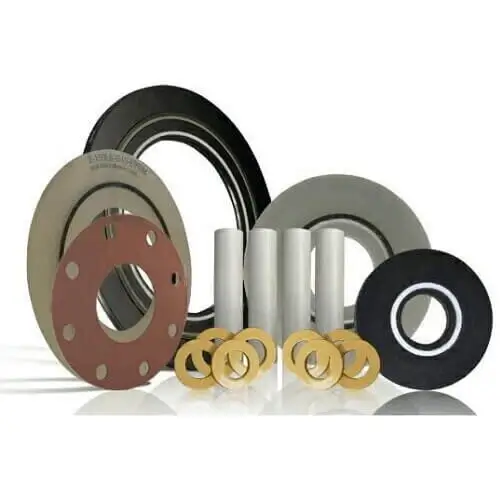
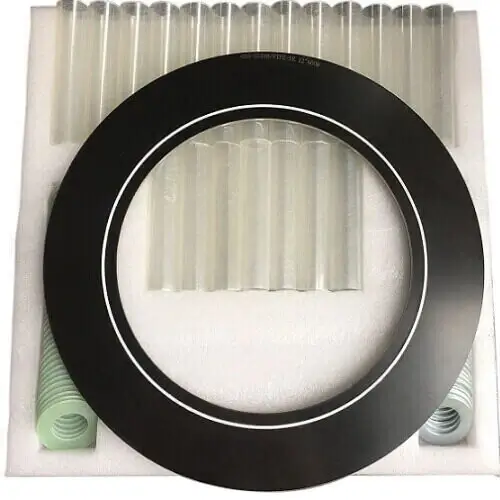
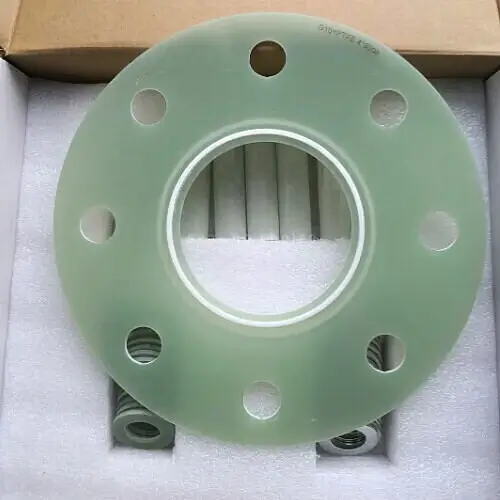
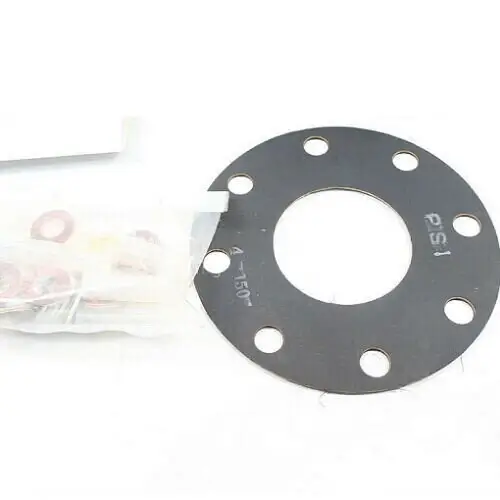
Type D Flange Insulation Gasket for RTJ Ring Type Joint Flanges
Type D Flange Insulation Gaskets are used for controlling losses due to corrosion. They can be used to control stray electric currents in piping at oil, gas, water, refinery, and chemical plants, to increase the effectiveness of cathodic protection systems. Type D insulation gaskets are available for RTJ flanges and can be produced according to ASME and API flange standards.
The KXT-150 sealing gasket is an excellent alternative to Type D gaskets because the sealing element may be positioned anywhere between the I.D. of the gasket and the I.D. of the ring groove. This gives higher confidence sealing on RTJ joints, especially on aged or slightly damaged ring grooves.
A Type D flange insulation gasket is an insulating ring joint gasket that fits the ring groove of a ring type joint (RTJ) flange. Type D insulation gaskets are available for RTJ flanges and can be produced according to ASME and API flange standards, usually in oval or octagonal shape. The gasket seals the ring joint and electrically isolates the two flanges from each other at the same time, so it controls corrosion losses and increases the effectiveness of the cathodic protection system.
Type D flange insulation gaskets are used for controlling losses due to corrosion. They can be used to control stray electric currents in piping at oil, gas, water, refinery and chemical plants, to increase the effectiveness of cathodic protection systems. Because RTJ flanges are used at high pressure — wellheads, Christmas trees, high-pressure process piping — the Type D insulation gasket is a critical component in the corrosion control system of those joints.
The KXT-150 sealing gasket is an excellent alternative to Type D gaskets because the sealing element may be positioned anywhere between the I.D. of the gasket and the I.D. of the ring groove. On a conventional Type D gasket, the seal is fixed at one position in the ring groove. On the KXT-150, the spring-energized Teflon seal can be positioned to match the actual groove geometry of the flange.
For RTJ flange isolation there are two standard solutions from Kaxite: the classic Type D insulating ring joint gasket, and the KXT-150 high-pressure sealing gasket. Both fit RTJ flanges, but the sealing approach is different.
Type D Insulating Ring Joint Gasket
A fabric-reinforced plain phenolic or G10 ring joint gasket produced to ASME and API flange standards. The gasket sits in the ring groove of the RTJ flange in oval or octagonal shape. The seal is achieved through the metal-to-metal contact of the ring joint with the insulating retainer providing the electrical barrier. Available in plain phenolic, silicone glass G-7, epoxy glass G-10 and epoxy glass G-11. Simple, cost-effective, and widely used across oil and gas pipeline isolation.
KXT-150 High Pressure Sealing Gasket
The KXT-150 uses a stainless steel core bonded with G10 or G11 insulating laminate and a spring-energized Teflon seal. The seal groove is machined into the stainless steel core, and the seal may be positioned anywhere between the I.D. of the gasket and the I.D. of the ring groove. Because the seal is not fixed at one position, the KXT-150 gives higher confidence sealing on aged or slightly damaged ring grooves, and seals at all pressures up to ANSI 2500# and API 15,000 PSI.
Type D flange insulation gaskets are available in four standard retainer materials. Each material has a different combination of dielectric strength, compressive strength, water absorption, insulating resistance, flexural strength and operating temperature. The table below compares the four materials side by side.
| Property | Plain Phenolic | Silicone Glass G-7 * | Epoxy Glass G-10 | Epoxy Glass G-11 |
|---|---|---|---|---|
| Dielectric strength (Volts/mil) | 500 | 350–400 | 550 | 550 |
| Compressive strength (psi) | 25,000 | 40,000 | 50,000 | 50,000+ |
| Water absorption (%) | 1.6 | 0.07 | 0.10 | 0.10 |
| Insulating resistance (Megohms) | 40,000 | 2,500 | 200,000 | 200,000 |
| Flexural strength (psi) | 22,500 | 27,000 | 45,000 | 43,000 |
| Operating temp (°F) | -65 to +220 | -292 to +450 | -292 to +280 | -292 to +350 |
| Operating temp (°C) | -54 to +104 | -180 to +232 | -180 to +138 | -180 to +177 |
Kaxite produces three standard flange-facing geometries for flange insulation gaskets. The geometry is set by the flange type, not by the retainer material — so the same phenolic, G-7, G-10 or G-11 retainer can be cut into any of the three types.
| Feature | Type E | Type F | Type D |
|---|---|---|---|
| Flange face | Full face / raised face | Raised face only | RTJ ring groove |
| Outside diameter | Same as flange OD | Slightly smaller than bolt circle | Fits ring groove |
| Bolt holes | Yes, full bolt circle | No | No |
| Standard shape | Round flat gasket | Round ring gasket | Oval or octagonal |
| Typical use | General water, gas, oil piping | Raised-face flanges | High-pressure RTJ flanges |
| Standard | ASME B16.5 | ASME B16.5 | ASME B16.20 · API |
Type D flange insulation gaskets are used wherever an RTJ flange joint must be sealed and electrically isolated at the same time. The most common applications are listed below.
Wellhead and Christmas Tree
RTJ flanges on wellheads and Christmas trees where the joint must be sealed and electrically isolated at high pressure to protect the cathodic protection system.
High-Pressure Process Piping
Refinery and petrochemical process piping in RTJ flange service where corrosion losses must be controlled and stray currents must be isolated.
Oil and Gas Pipelines
Transmission and distribution pipelines where RTJ flanges are used and isolation joints are required at regular intervals for corrosion control.
Compressor and Pump Stations
Compressor and pump discharge connections where the RTJ flange joint must be isolated under vibration and pressure cycling.
Gas Transmission Facilities
Gas transmission and metering facilities where RTJ flanges are used and the cathodic protection system must be isolated from the next pipeline section.
Dissimilar Metal RTJ Joints
Where a carbon steel RTJ flange is bolted to a stainless steel or alloy flange — the Type D gasket breaks the galvanic circuit at the ring groove.
The table below defines the fit, function and options of the Type D flange insulation gasket. Confirm the exact flange size, pressure class, retainer material and shape on the enquiry — custom gaskets to drawing are accepted.
ASME · API flange standards
350 – 550 Volts/mil depending on retainer material
25,000 – 50,000+ psi depending on retainer material
2,500 – 200,000 Megohms depending on retainer material
-180 °C to +232 °C depending on retainer material
What is a Type D flange insulation gasket?
A Type D flange insulation gasket is an insulating ring joint gasket that fits the ring groove of a ring type joint (RTJ) flange. Type D insulation gaskets are available for RTJ flanges and can be produced according to ASME and API flange standards, usually in oval or octagonal shape. The gasket seals the ring joint and electrically isolates the two flanges from each other at the same time, so it controls corrosion losses and increases the effectiveness of the cathodic protection system.
What is the difference between Type D, Type E and Type F flange insulation gaskets?
Type D fits RTJ ring groove flanges only. Type E is a full-face gasket with the same outside diameter as the flange and precision-cut bolt holes, so it protects the entire flange face. Type F is for raised-face flanges only — no bolt holes, and the outside diameter is slightly smaller than the bolt circle so the gasket centres between the bolts. The same retainer material can be cut into any of the three types.
Why is the KXT-150 sealing gasket an excellent alternative to a Type D gasket?
The KXT-150 sealing gasket is an excellent alternative to Type D gaskets because the sealing element may be positioned anywhere between the I.D. of the gasket and the I.D. of the ring groove. On a conventional Type D gasket, the seal is fixed at one position in the ring groove. On the KXT-150, the spring-energized Teflon seal can be positioned to match the actual groove geometry of the flange, which gives higher confidence sealing on RTJ joints, especially on aged or slightly damaged ring grooves.
What retainer materials are available for Type D flange insulation gaskets?
Retainer materials include plain phenolic, silicone glass G-7, epoxy glass G-10 and epoxy glass G-11. Plain phenolic is the standard for general service. G-10 and G-11 epoxy glass are selected for higher mechanical strength and higher dielectric strength. G-7 silicone glass is selected for very high temperature dry service, but must not be used with hydrocarbons, not even trace amounts.
What are the physical properties of Type D flange insulation gaskets?
Dielectric strength 350–550 Volts/mil. Compressive strength 25,000–50,000+ psi. Water absorption 0.07%–1.6%. Insulating resistance 2,500–200,000 Megohms. Flexural strength 22,500–45,000 psi. Operating temperature range -180 °C to +232 °C. The exact values depend on the retainer material — plain phenolic, G-7, G-10 or G-11.
What standards do Type D flange insulation gaskets meet?
Type D flange insulation gaskets can be produced according to ASME and API flange standards. Oval and octagonal shapes are both available, and custom shapes to customer drawing are accepted. The gaskets are supplied either as a single insulating ring joint gasket or as a complete kit with insulating sleeves, insulating washers and zinc-plated steel washers.
Send us your specification — we reply within 24 hours
Tell us the RTJ flange size, the pressure class, the gasket shape (oval or octagonal), the retainer material (plain phenolic, silicone glass G-7, epoxy glass G-10 or epoxy glass G-11), the flange standard (ASME or API), the quantity, and whether you want a standalone Type D gasket or a complete kit with sleeves and washers. If you are considering the KXT-150 sealing gasket as an alternative to Type D, send us the ring groove drawing and the process conditions and we will advise the correct solution.
Address
No 432 Zhenhai Middle Road, Luotuo Street, Zhenhai District, Ningbo City, Zhejiang China
Tel