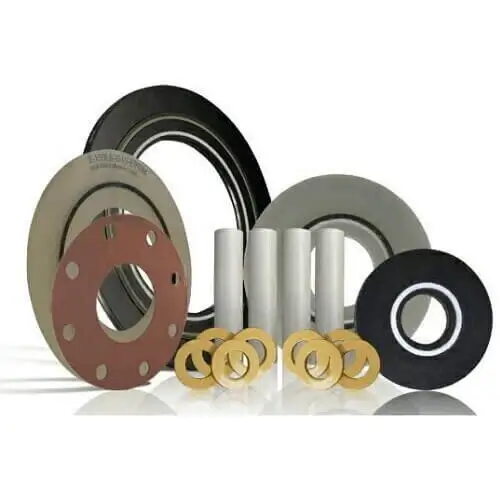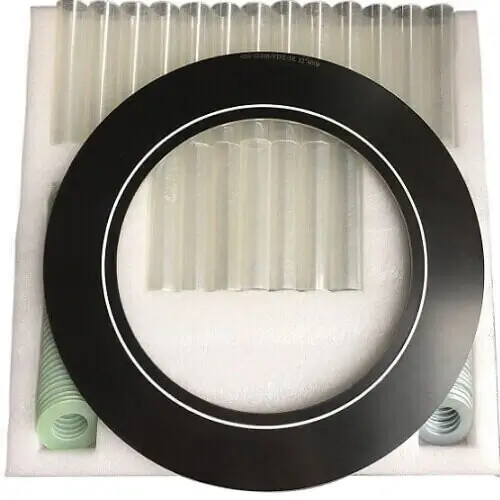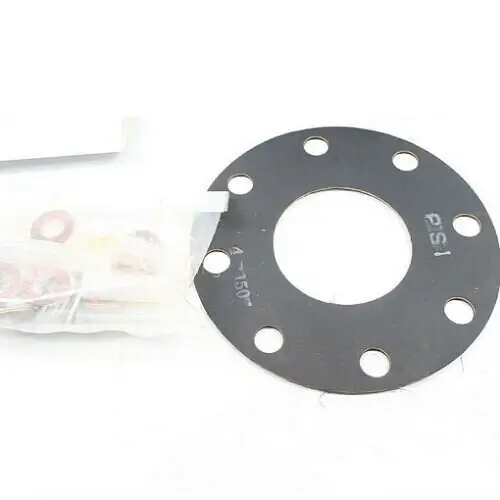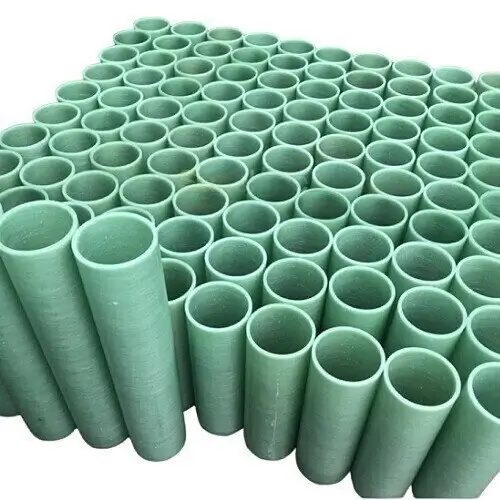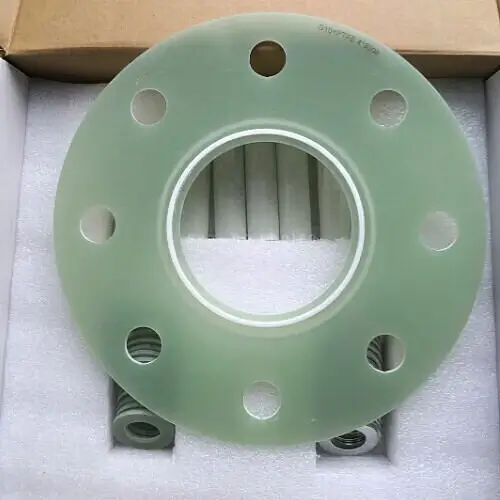
Type E Flange Insulation Gasket Kit
A full-face isolation gasket with the same outside diameter as the flange and precision-cut bolt holes. The bolt holes keep the gasket centered during installation and prevent foreign material from shorting the flange isolation. Available in plain phenolic, nitrile faced phenolic, G10, G11 and G7. Standard thickness 3.2 mm.
Gasket Type
TYPE E
Full-Face · Bolt-Hole Centered · ANSI B16.5 · ASME B16.47
A Type E flange insulation gasket kit is a full-face isolation gasket with the same outside diameter as the flange and precision-cut bolt holes. The bolt holes keep the gasket centered during installation and prevent foreign material from shorting the flange isolation. The Type E design is the most common geometry for raised-face and flat-face flanges where the gasket must cover the entire flange face.
The kit is called Type E because the gasket covers the entire flange face — bolt hole to bolt hole — rather than sitting inside the bolt circle like a Type F gasket. This full-face construction makes the Type E flange insulation gasket kit easy to align, hard to mis-install, and suitable for both new pipelines and retrofit isolation joints.
The purpose of the Type E flange insulation gasket kit is to seal a bolted pipe joint and electrically isolate the two flanges from each other. When a carbon steel flange is bolted to a stainless steel, brass or cast iron flange and an electrolyte is present, a galvanic current can flow between the two metals and corrode the more active one. The Type E gasket breaks that circuit. The same kit is also used to isolate a cathodic protection system on buried or submerged pipelines.
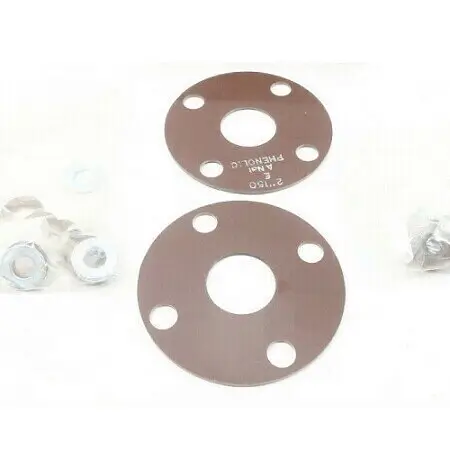
The parameters below define the fit and function of the Type E flange insulation gasket kit. Confirm the exact flange size, pressure class, material and standard on the enquiry.
3.2 mm
All three geometries use the same isolation material — the difference is the shape of the gasket and the flange face it is designed for. The same phenolic, G10 or G11 sheet can be cut into any of the three types.
| Feature | Type E | Type F | Type D |
|---|---|---|---|
| Flange face | Full-face / raised-face | Raised-face only | RTJ ring groove |
| Outside diameter | Same as flange OD | Slightly smaller than bolt circle | Fits ring groove |
| Bolt holes | Yes — full bolt circle | No | No |
| Alignment | Bolt holes center the gasket | Centered between bolts | Seated in ring groove |
| Typical use | General water, gas, oil piping | Raised-face flanges | High-pressure RTJ flanges |
| Standard thickness | 3.2 mm | 3.2 mm | Per RTJ groove |
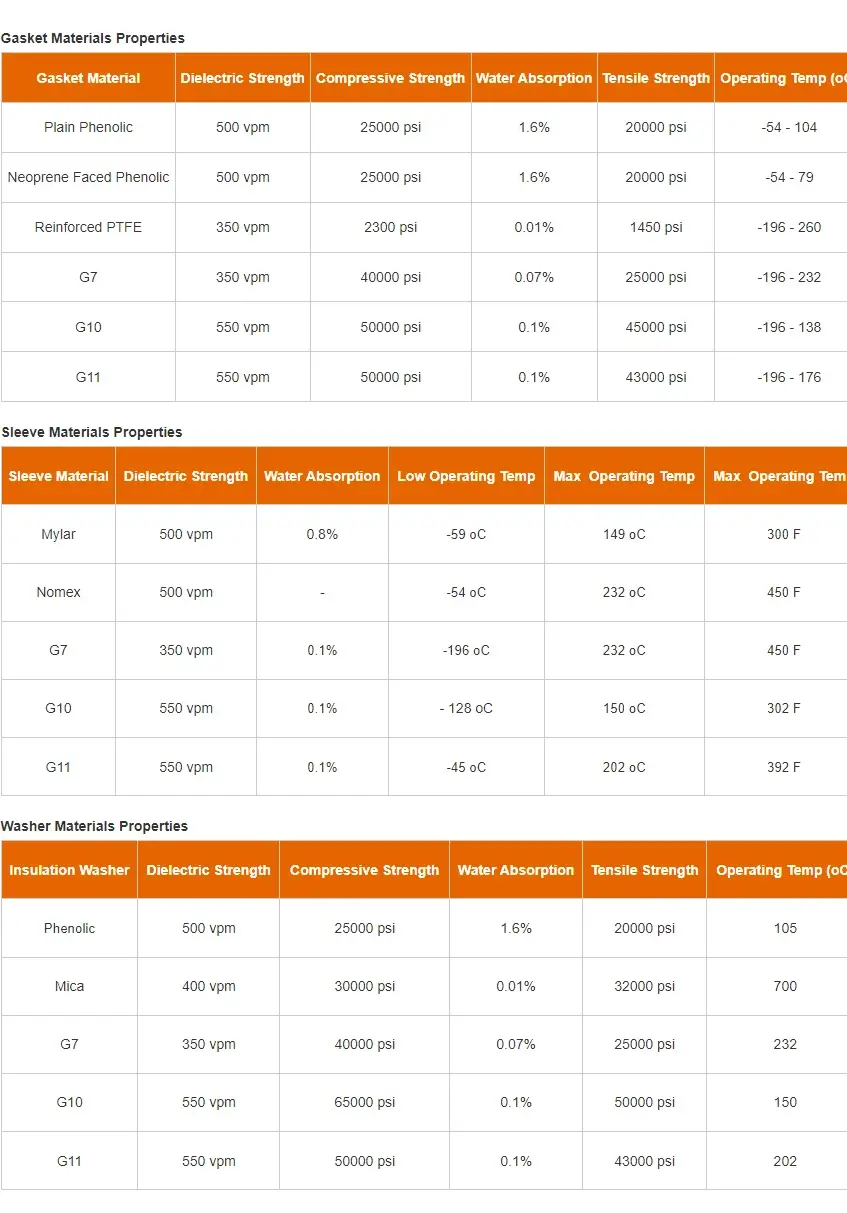
The Type E flange insulation gasket kit is available in five standard materials. Each material is selected for a different combination of temperature, chemical resistance and electrical resistance.
Plain Phenolic
Fabric-reinforced phenolic retainer with no facing. Used for dry service and general water, gas and oil piping. High compressive strength and good electrical resistance.
Max +105 °CNitrile Faced Phenolic
Phenolic core with nitrile (NBR) rubber facing on both sides. Suitable for oil, fuel, steam and general chemical service. Softer seating than plain phenolic.
Max +79 °CG10 Epoxy Glass
Epoxy resin bonded glass cloth. High mechanical strength, low water absorption, excellent electrical insulation. Common for high-pressure isolation joints.
Max +130 °CG11 Epoxy Glass
Higher-temperature epoxy glass laminate with improved thermal and chemical resistance compared with G10. Used in refinery and petrochemical service.
Max +155 °CG7 Silicone Glass
Silicone resin bonded glass cloth. Selected for high-temperature dry service where epoxy materials are not suitable. Lower mechanical strength than G10/G11.
Max +180 °CCustom Materials
Other materials such as neoprene faced phenolic, Viton faced and PTFE faced constructions are available on request. Send the process conditions and we will match the material.
On requestThe Type E flange insulation gasket kit is installed in the same sequence as any full-face isolation kit. The bolt holes in the Type E gasket make alignment easier than a Type F gasket, but the sleeve and washer sequence must still be followed exactly to preserve the isolation.
Check the kit contents
Confirm that the kit contains the Type E gasket, Mylar® isolation sleeves for every bolt, and ZPS backing washers.
Clean and inspect the flange faces
Remove dirt, rust and old gasket material from both flange faces. Apply lubricant to all bolt threads.
Position the gasket and flanges
Place the Type E gasket between the flanges and align the bolt holes. Use alignment pins in two diametrically opposite bolt holes where possible.
Insert the Mylar® isolation sleeves
Push one Mylar® sleeve into each bolt hole. Do not force the sleeve — forcing can damage the sleeve material and short the isolation.
Fit bolts, insulating washers and steel washers
Insert the bolt with an insulating washer on each side of the flange, then the steel washer and nut. The insulating washer must sit between the steel washer and the flange face.
Tighten in stages
Tighten two diametrically opposite bolts to 30% of the final torque. Remove the alignment pins, replace with bolts, then tighten all bolts to 50% and finally to 100% of the final torque value.
Check bolt length
Installed bolts should extend through the nut by approximately 1/4″ (6 mm) to allow full thread engagement.
The Type E flange insulation gasket kit is specified wherever a full-face flange joint must be sealed and electrically isolated at the same time — most commonly to stop galvanic corrosion between dissimilar metals or to isolate a cathodic protection system.
Water Pipelines
Large-diameter water and wastewater transmission mains where the flange joint must be isolated to protect the pipeline coating.
Gas Transmission
Gas transmission and distribution lines where isolation joints are required at regular intervals for corrosion control.
Oil & Fuel Service
Oil, fuel and hydrocarbon pipelines where the joint must be sealed and electrically isolated at the same time.
Cathodic Protection
Buried or submerged pipelines where the cathodic protection system must be isolated from the next pipeline section.
Dissimilar Metal Joints
Where a carbon steel flange is bolted to a stainless steel, brass or cast iron flange — the Type E gasket breaks the galvanic circuit.
Refineries & Petrochemical
Process piping, heat exchanger nozzles and vessel connections where dissimilar metals meet at a full-face flange joint.
Pump & Valve Stations
Pump discharge, valve and meter connections where electrical isolation must be maintained.
Tank Farm & Terminal
Tank inlet and outlet flanges, loading and unloading lines — isolation of the tank from the process piping.
High-Pressure Service
G10 and G11 Type E gaskets for ANSI Class 900 to 2500 flange joints where high compressive strength is required.
Direct manufacturer
Ningbo Kaxite Sealing Materials Co., Ltd produces Type E flange insulation gasket kits at its own facility in Zhenhai District, Ningbo, Zhejiang, China — factory-direct supply without trading-company mark-up.
Five standard materials in one place
Plain phenolic, nitrile faced phenolic, G10, G11 and G7 — one source for a mixed Type E isolation gasket order, with material certificates on request.
Complete kit from one source
Type E gasket, Mylar® isolation sleeves and ZPS (zinc-plated steel) backing washers — one purchase order, one supplier, one quality standard.
Wide standard coverage
Gaskets are made to ANSI B16.5 and ASME B16.47 — covering water, gas, oil and petrochemical flange geometries in one catalogue.
Custom sizes to drawing
Non-standard flange sizes, special bolt circles and unusual pressure classes can be produced to customer drawing.
Traceable materials
Material certificates can be provided on request so your QA department can verify grade and properties before installation.
What is a Type E flange insulation gasket kit?
A Type E flange insulation gasket kit is a full-face isolation gasket with the same outside diameter as the flange and precision-cut bolt holes. The bolt holes keep the gasket centered during installation and prevent foreign material from shorting the flange isolation. Type E gaskets are used together with Mylar® isolation sleeves and ZPS (zinc-plated steel) backing washers to break every electrical path through the flange joint.
What is the difference between Type E, Type D and Type F flange insulation gaskets?
Type E is a full-face gasket — same outside diameter as the flange, with precision-cut bolt holes. Type F is for raised-face flanges only — no bolt holes, and the outside diameter is slightly smaller than the bolt circle so the gasket centers between the bolts. Type D is designed for RTJ ring groove flanges and is supplied in oval or octagonal shape. The same material can be cut into any of the three types.
What materials are available for Type E flange insulation gaskets?
Type E flange insulation gaskets are available in plain phenolic, nitrile faced phenolic, neoprene faced phenolic, G10 epoxy glass, G11 epoxy glass and G7 silicone glass. Plain phenolic and G10 are the most common for general water, gas and oil service. G11 and G7 are selected for higher temperature or higher electrical resistance requirements.
What is the standard thickness of a Type E flange insulation gasket?
The standard thickness of a Type E flange insulation gasket is 3.2 mm. Other thicknesses are available on request for special pressure classes, misaligned flanges or custom retainer designs.
How do you install a Type E flange insulation gasket kit?
Clean and inspect both flange faces. Place the Type E gasket between the flanges and align the bolt holes. Insert Mylar® isolation sleeves into each bolt hole without forcing. Fit the bolt with an insulating washer on each side, then the steel washer and nut. Tighten two diametrically opposite bolts to 30% of final torque, replace alignment pins with bolts, then tighten all bolts to 50% and finally to 100% of the final torque value.
What standards does the Type E flange insulation gasket meet?
Type E flange insulation gaskets are manufactured to ANSI B16.5 and ASME B16.47. Custom gaskets to customer drawing are also accepted. The standard kit contents — gasket, Mylar® sleeves and ZPS washers — are supplied together as a matched set.
Send us your specification — we reply within 24 hours
Tell us the flange size, the pressure class, the flange type (Type E full-face, Type F raised-face or Type D RTJ), the material (plain phenolic, nitrile faced phenolic, G10, G11 or G7), the standard (ANSI B16.5 or ASME B16.47), the quantity, and the required kit scope (gasket only, or the complete kit with Mylar® sleeves and ZPS washers). If you are not sure whether you need the Type E, Type F or Type D geometry, send us the flange drawing and the process conditions and we will match the correct kit.
Address
No 432 Zhenhai Middle Road, Luotuo Street, Zhenhai District, Ningbo City, Zhejiang China
Tel